
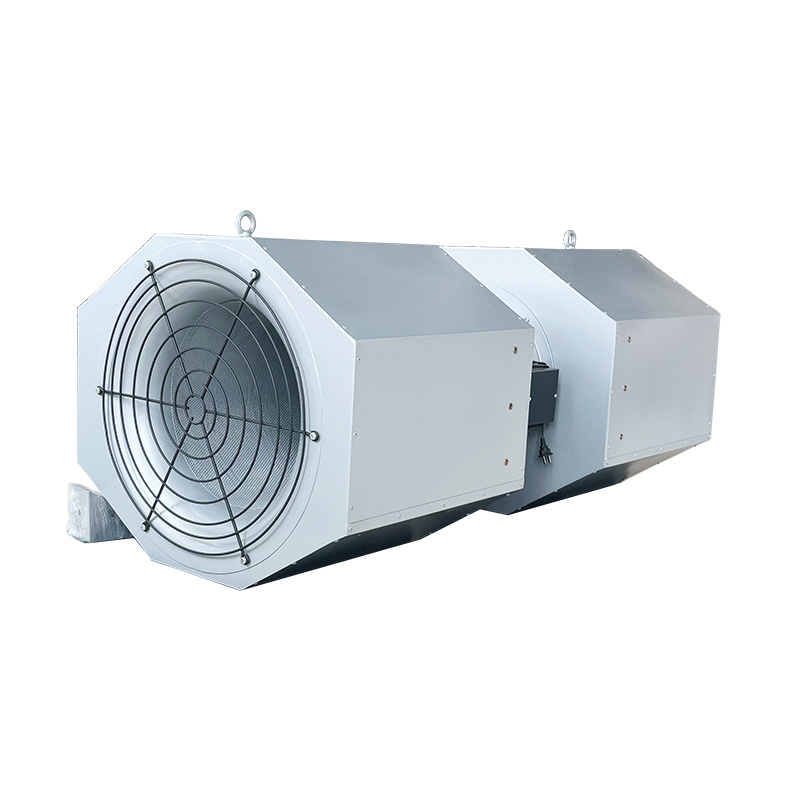
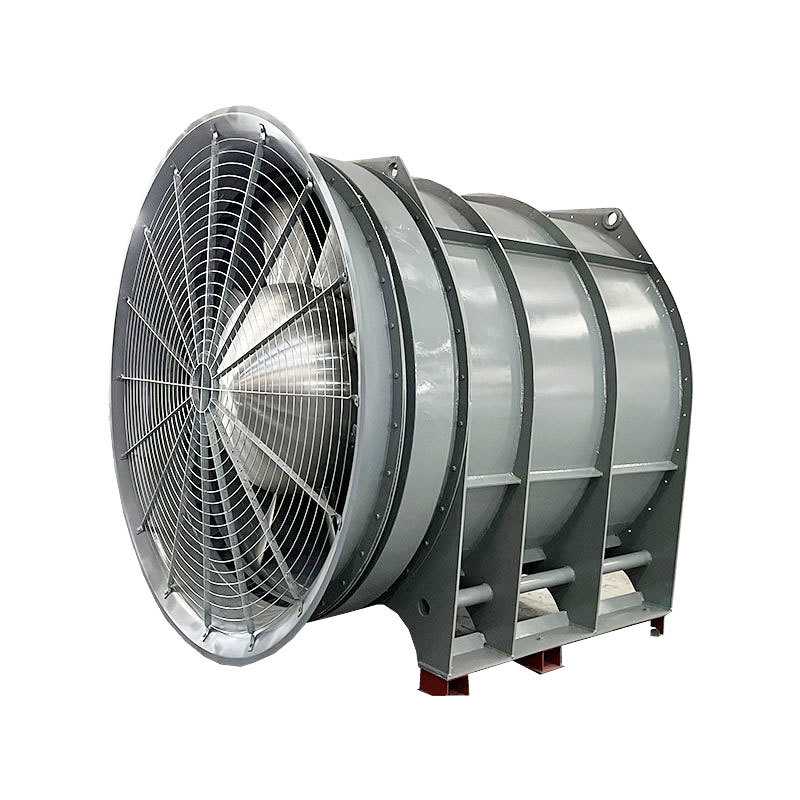
SDS TYPE METRO TUNNEL JET FAN
Categories:
Impeller diameter:630~1250mm
Range of air volume :8.1~51.5m³/s
Range of Thrust : 2500N
Motor output power : <90kw
Operating Temperature :280℃, 60min,3CF
Keywords:Ventilation equipment
Telephone:
E-mail:
SDS TYPE METRO TUNNEL JET FAN
Details
Overview of 1. SDS jet fan
SDS series jet ventilator is a new product developed by our company and Shanghai Jiao Tong University on the basis of mechanism research results and advanced technologies such as Japan and Germany. The engineering technology center of the company is committed to continuous research and development of theoretical technology and technological innovation. It also has extensive exchanges with ABB and other international companies and fully investigates the subway, highway, railway tunnel, water conservancy dam engineering and other systems at home and abroad, at the same time, we consulted the experts of the subway design institute, tunnel design and tunnel installation company, mastered the use requirements of the fan, and accumulated rich experience in product technology, quality requirements and use conditions. So that the fan has efficiency and than A sound level is better than regular ordinary axial flow fan, its fan variety specification selection, optimize all kinds of working system matching in the domestic leading level.
SDS series jet fans have specifications from 630mm to 1600mm, and are divided into two categories: one-way operation axial flow fans and reversible (two-way) operation axial flow fans. The maximum thrust is 3500N, for either. Load and working conditions can choose efficient, low noise fan.
SDS series jet fan adopts advanced technology to achieve good quality assurance. The fan shell adopts domestic advanced special numerical control machine tool for spinning and flanging. The inner wall of the front section of the impeller is processed by gold, which not only ensures the coaxiality and strength of the shell, but also ensures the longitudinal clearance of the blade. The appearance is treated by hot dip galvanizing, with beautiful appearance and excellent anti-corrosion performance, fan blades and hubs are processed into die-casting mold cavities by domestic advanced full CNC boring and milling centers, and aluminum alloy high (low) die-casting is carried out in high-pressure casting and low-pressure casting machines respectively. The actual use of subways, highways, railway tunnels, water conservancy dam projects and other users has proved that the performance indicators and corrosion resistance, reliability, economy and other technical, quality requirements and economic indicators of the fan are fully adapted to the use of various types of tunnels and subways.
2. SDS series jet ventilator code representation

3. SDS series jet fan selection reference
1. Main features of fan
Hanfeng SDS series jet fans have the advantages of low noise, large flow rate, high thrust, etc. All indexes meet the requirements of JB/T10489-2004 "Design Conditions of Jet Fans for Tunnels" and GB/T19843-2005/IS013350:1999 "Performance Test of Jet Fans for Industrial Ventilators.
Under the specified working conditions, the design service life of the fan is at least 10 years (except for wearing parts), and the safe operation time before the first overhaul is not less than 2000h.
High temperature resistance: the fan in the gas temperature 250C continuous operation within 60min, there will be no mechanical, electrical or structural failure.
The ratio of the reverse flow rate to the forward flow rate of the unidirectional jet fan can reach 50%-70%; the ratio of the reverse flow rate to the forward flow rate of the bidirectional reversible jet fan is greater than 96%.
The noise limits of each type of jet fan are in line with the provisions of the JTJ026.1-1999 Code for Design of Ventilation and Lighting of Highway Tunnels: the sound level measured by the fan in the field, 10m away from the center point of the fan outlet, and at an angle of 45 with the fan axis does not exceed 77dB(A).
The supporting strength of the fan installation hanger is more than 15 times of the static load of the fan, and the installation is convenient. The structure size of the hanger can be adjusted according to the actual embedded parts of the tunnel.
The jet fan is set at 15cm ~ 20cm of the tunnel building boundary, and the fan axis is parallel to the tunnel axis. The setting method of the fan should be fixed or suspended.
All parts of the jet fan are treated with anti-corrosion and anti-rust, coated with two layers of high temperature resistant anti-rust primer and two layers of high temperature resistant topcoat. For special requirements, the muffler orifice plate adopts stainless steel plate, the fan surface is galvanized, and the connecting bolt is stainless steel bolt.

2, Tunnel ventilation system design and product selection basis
In principle, traffic tunnels can be divided into three categories: subways, road tunnels and railway tunnels.
2-2, regular operation and emergency operation safety, reliability of the prerequisite is to install to ensure coordination between the system and give full play to the role of the environmental control system.
A mechanical system: ventilation, fire fighting, sewage discharge: B power system: power supply, power transmission and distribution, emergency power c lighting system lighting, local lighting, fluorescent indicator d communication system: telephone, radio computer terminal
E Traffic system: lights, signals, signs, monitoring F Control system: control of traffic conditions and equipment operating conditions
2-3, tunnel ventilation system can have the following three basic ways and can take a hybrid.
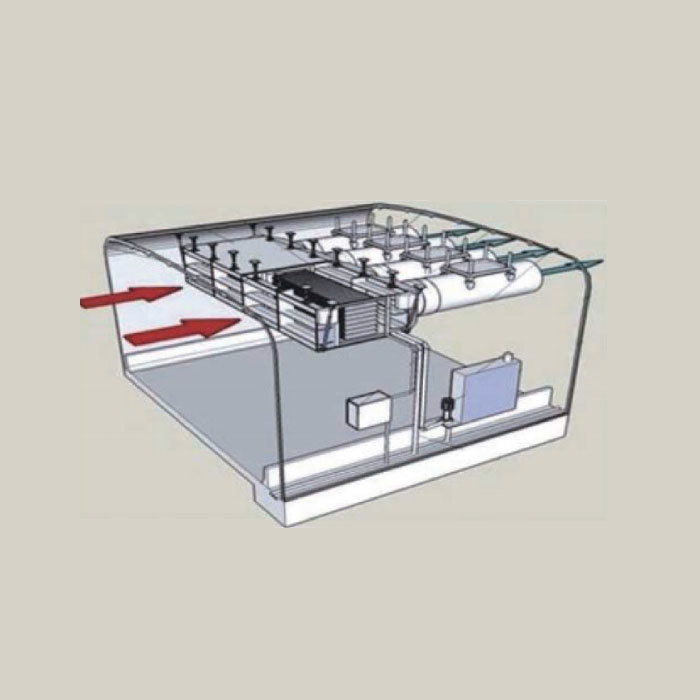
Longitudinal ventilation system: This is the most basic way of ventilation. The new ventilation flow flows from the inlet end to the outlet end of the tunnel, and there is no need to install ventilation ducts along the longitudinal direction of the tunnel. The ventilation mode generally selects the reversible jet fan. The fan is installed on the top or side of the tunnel, which can be fully ventilated in two directions to achieve two-way ventilation or smoke control; if the tunnel is long, a central air supply and exhaust shaft must be added, and the shaft is connected with the atmosphere to form a mixed ventilation mode.
② Full transverse ventilation system: air supply and exhaust ducts are set along the tunnel direction. Fresh air is collected from the air pavilion and exhaust air is discharged from the air tower. Generally, the air supply duct is set below the road surface and the exhaust duct is set at the upper part of the driveway. The air supply duct is not separated from the exhaust duct-fixed. Air supply and exhaust outlets are arranged at intervals. Under accident conditions, even if the cross-section of the tunnel exhausts air, smoke is pumped out.
③ Semi-transverse ventilation system: The system can be divided into air supply type semi-transverse ventilation mode and exhaust type semi-transverse ventilation mode. The same exhaust type semi-transverse ventilation mode is adopted. Fresh air enters from the entrance of the tunnel, and the exhaust air phase is a full transverse ventilation system.
2-4, tunnel ventilation system should consider the factors
A, project investment B, power capacity C, operating costs.
D, air quality e, safety factor f, assurance measures in case of emergency
The above factors are integrated to establish the optimization scheme.
2-5. Factors for selection of number and number of fans in tunnel ventilation system
A, CO, NOX and smoke concentration B, traffic flow (traffic density, speed) c, force load (tunnel length, width and height) d, exhaust emission (vehicle age, quantity) e, emergency measures in case of fire
2-6, tunnel ventilation system thrust computer theoretical basis.
① Theoretical basis for thrust calculation of tunnel ventilation system
● Loss of inlet and outlet resistance
● Friction coefficient of tunnel surface and equipment
● Vehicle friction coefficient (calculation of motion or piston wind effects under the most inferior conditions)
● Influence of wind speed outside the tunnel on the exit and entrance under the most inferior conditions. Topography and location (slope and altitude) of the tunnel
● Thrust required in case of fire (temperature, pressure, time)
② Tunnel pressure reduction (pa) theory is converted into thrust required for jet fan (N)
The thrust of the jet fan is the momentum change of the fan inlet and outlet, that is, the fan thrust
NS-C01 mass flow velocity (N)
Chinese style: Ns = static thrust of fan (LS0) N value C1 = empirical correction coefficient
Mass flow = air density x volume flow
The relative velocity between the jet fan used in the tunnel and the airflow in the tunnel, the friction coefficient in the tunnel are related to the influence of the parallel arrangement of the same group, so the effective thrust of the jet fan is: Ne = NsX (1-Vt/Vj) C2XC3
Where Ne = effective thrust of fan (N) Vt = wind speed in tunnel (m/s)Vj = jet velocity (m/s) C2 = friction coefficient in tunnel
C3 = flow loss of parallel arrangement in the same group (the loss is 100 times the diameter of the fan as the unit, so that the jet speed does not affect the operating conditions of the main direction of the downstream air flow can be not considered).
2-7, tunnel ventilation system application fan structure characteristics
 According to the above figure, tunnel fans are divided into two specifications: with muffler and without muffler [inlet and outlet plus collector (diffuser)], and two ventilation forms: unidirectional jet fan (SDS) and bidirectional jet fan [SDS(R)].
Fan casing, flow collecting (dispersing) device, muffler and supporting feet: adopt steel plate numerical control automatic welding and mechanism forming, and adopt hot-dip galvanizing or hot-dip galvanizing followed by dry film epoxy resin treatment to ensure the strength and corrosion resistance of the fan.
Fan impeller: In order to meet the needs of tunnel ventilation, SDS series fans can change the number of blades and change the angle of fan blades. Muffler: The length of the muffler is usually twice the diameter of the fan. When the noise requirement is high, it can also be twice the diameter of the fan. The muffler and the fan body are fixed by bolts.
The matching motor of SDS series jet ventilator is fully enclosed with squirrel cage. The motor is equipped with flange mounting plate. The insulation of the motor is Class H and the protection grade is IP55. The lead-out cable of the motor can be connected to the junction box on the casing of the fan body. The motor is equipped with lubricating grease nozzle, and the external metal hose is connected to the lubricating grease nozzle on the casing of the fan body.
Reversible switching time of the fan: in an emergency, the forward and reverse switching time of the jet fan is extremely important. SDS (R) type fan has electronic and mechanical switching methods, which can be switched to the rated speed of the fan within 30 seconds.
3. Test and inspection of SDS series jet ventilator
Thrust test: measured by thrust test device.
High temperature fire test: by the Ministry of Public Security Tianjin Fire Test and Testing Center test.
Noise test: both the muffler installed and the muffler not installed at the inlet and outlet of the fan are tested in an open field (when the atmospheric wind speed is close to 0), and the sound pressure level of the fan is measured at a distance of 10m from the fan casing at an angle of 45 ° along the fan axis.
Fan efficiency: fan operating efficiency is defined by measured thrust (N) and motor input power (kw). The test is carried out by the Engineering Technology Center (Test and Research Center) of Hanfeng Company in strict accordance with relevant national and industry standards, and is tested by provincial and national authoritative supervision agencies.

4. Commissioning and operation of SDS series jet fan
1. After the fan is installed, carefully check the following items before the fan starts:
● Whether the voltage is within the normal range (usually 380V soil 6%) and whether the three phases are balanced;
● Check whether the clearance of the blade tip meets the requirements, and turn the impeller by hand to check whether there is rubbing phenomenon; ● Check whether there are impurities and foreign bodies in and near the fan, if any, it should be removed immediately;
● Click the switch to try to turn the fan, and check whether the rotation direction of the fan impeller is consistent with the direction shown on the sign. If not, cut off the power supply and exchange the power supply wiring 2 with each other;
● Check whether the rated speed of the motor is consistent with the rated speed of the fan; ● Check the grounding wire and current protector (fuse) as required;
● The commissioning of the fan can only be started after the above inspections are completed. If severe vibration occurs during the commissioning, the power supply of the fan should be cut off immediately, and the fan should be checked after it stops.
● If everything is normal, the fan will stop after 10~30 minutes of trial operation, and check whether the blade bolts are loose. If there is no looseness, the fan can enter the normal state by standby.
2. During normal operation of the fan, first of all, pay attention to the motor current, which is the signal of the fan load and fault display; secondly, regularly check the vibration of the fan and the motor, and pay attention to whether there is an abnormal sound of friction and impact.
3. During normal operation of the fan, the fan should be stopped immediately for inspection or repair when the following conditions occur: ● The current suddenly increases and exceeds the normal range; ● Abnormal vibration or impact sound; ● The temperature of the motor bearing rises sharply.
Online message


E-mail:zjhff@vip.163.com
Tel:400-889-1119
Zipcode:312300
Add:West Zone of Zhangzhen Industrial Functional Zone, Shangyu District, Shaoxing City, Zhejiang Province, China


Copyright©Zhejiang Hanfeng Fan Co. Ltd.,